EquiNex vs. Equilab: an honest comparison for trail riders
Swipe to see more →
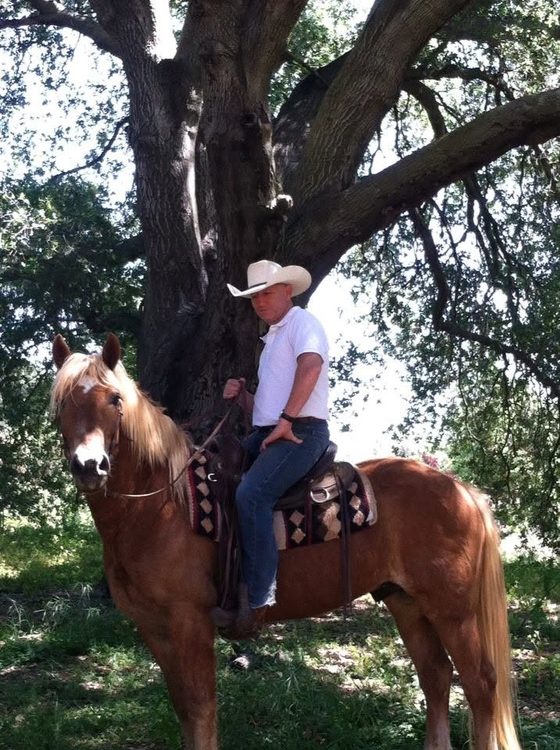
Equilab is a well-known riding tracker, and using any tracker beats riding with nothing. EquiNex is a newer player in the field — but the differences that matter to a rider on a trail are big, and they deserve a straight answer.
The two apps are built around different things. Equilab's claim to fame is training analysis — gait detection, transitions, charts of how you rode. EquiNex is built around horse care and trail riding — for pleasure, and for safety. The differences show up exactly where you'd want them to: the moment something goes wrong on the trail.
The two apps at a glance
| EquiNex | Equilab | |
|---|---|---|
| Ride tracking (GPS, speed, elevation) | Yes | Yes |
| Live ride sharing (no app needed to view) | Yes | Premium only; watch-only web link1 |
| Safety alert trigger | Detects the fall itself (motion signature), then auto SMS + email with GPS | Alert after ~5 min of no movement1 — a timer, not fall detection |
| Spoken "Are you OK?" check-ins after a fall | Yes — out loud, every 30 seconds | Not a published feature1 |
| Works with phone in pocket or saddlebag | Yes | Tracking yes; see note on safety above |
| Per-horse calibration | Yes — learns each horse's motion baseline | Not a published feature1 |
| Manual SOS with GPS to contacts | Yes — hold-to-send | Not a published feature1 |
| Gait analysis | In development — learned per horse, not fixed speed thresholds | Yes |
| Training analytics & trends | Ride stats, AI ride insights | Premium only |
| Horse care: vet & farrier appointments, feed schedules, deworming, shared barn calendar | Yes | Training planning & document storage1 |
| AI photo analysis (injuries, skin conditions) | Yes | Not a published feature1 |
| Group rides with live positions | Yes | Not a published feature1 |
| Trail markers (hazards, water, gates) on the route | Yes — shared with the trail | Photos recently added; waypoint markers not a published feature1 |
| Keeps recording & catches up in dead zones | Yes — buffered crumb trail | Not a published feature1 |
| Emergency contact needs the app? | No — alerts arrive by SMS + email, map opens in any browser | To be alerted, yes — no-movement alerts go only to contacts with the app; the web link is watch-only1 |
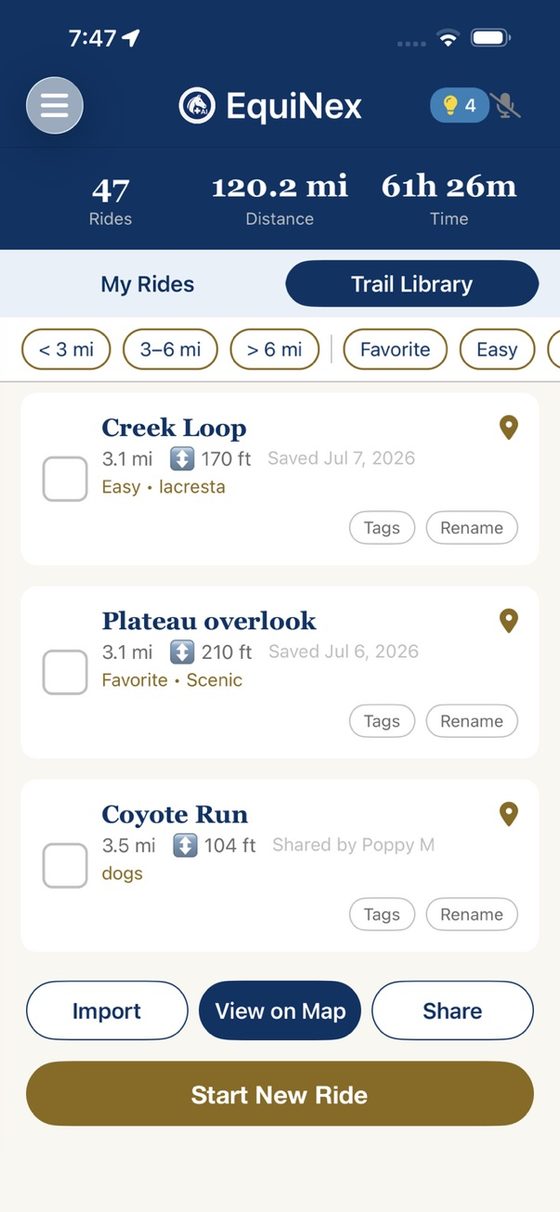
| Trail sharing & trail library | Build & share your trail library free; riding trails shared with you is a paid feature | Premium only |
Comparison reflects each product's publicly published features as of July 2026 — see sources below. If we've gotten something wrong about Equilab, tell us and we'll correct it.
The rest of this page is the story behind that table — starting with the row that matters most.
What happens when you come off
Equilab's Live Safety Tracking shares your location with your contacts and, per Equilab's published feature description, sends them an alert if you stop moving for more than about five minutes.1 But "stopped moving" is a proxy, not a detection: it can't tell a water break from an unconscious rider, and the clock only starts after you've already been down a while. And if your horse bolts home with your phone in the saddlebag, the phone never stops moving at all.
EquiNex takes a different approach — the one we hold a patent filing on. Your phone's motion sensors recognize the kinetic signature of the fall itself: the impact, the rotation, what your body and your horse do in the seconds after — and how it differs from what came before. Then a deliberate escalation begins:
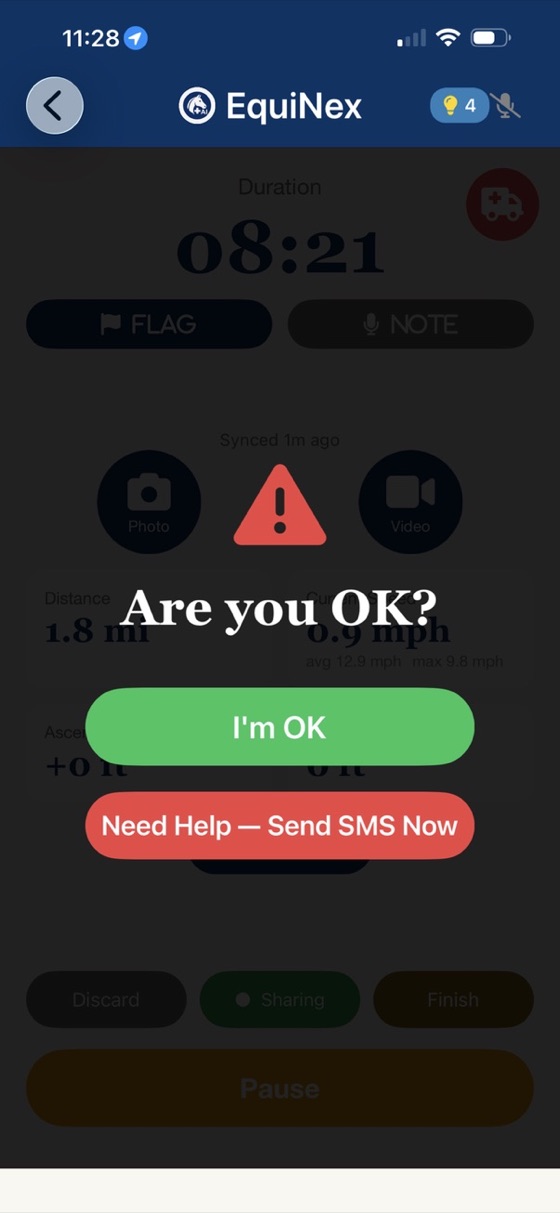
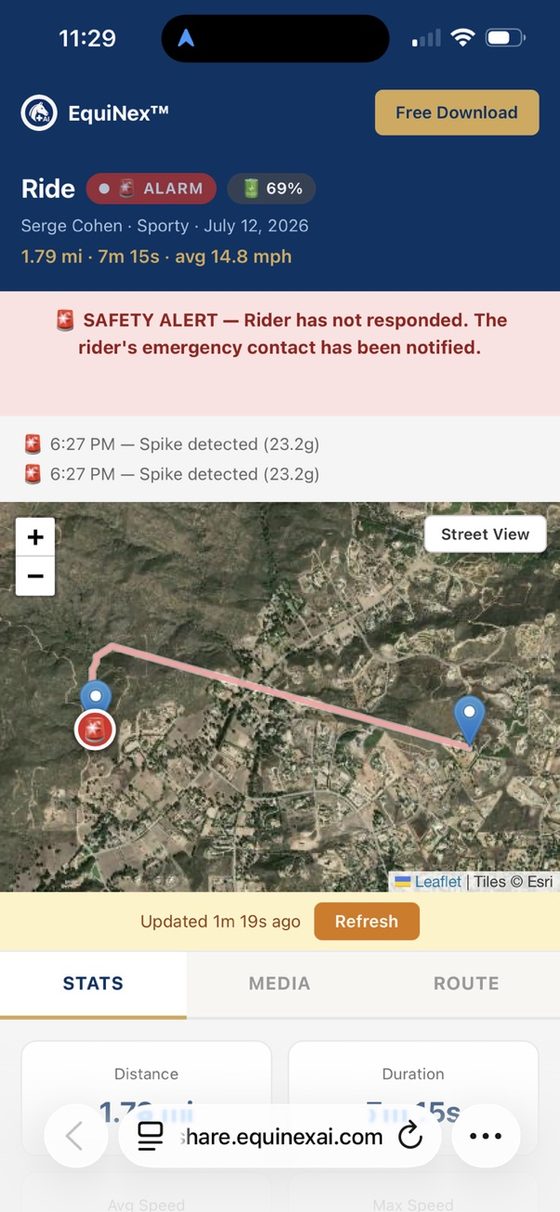
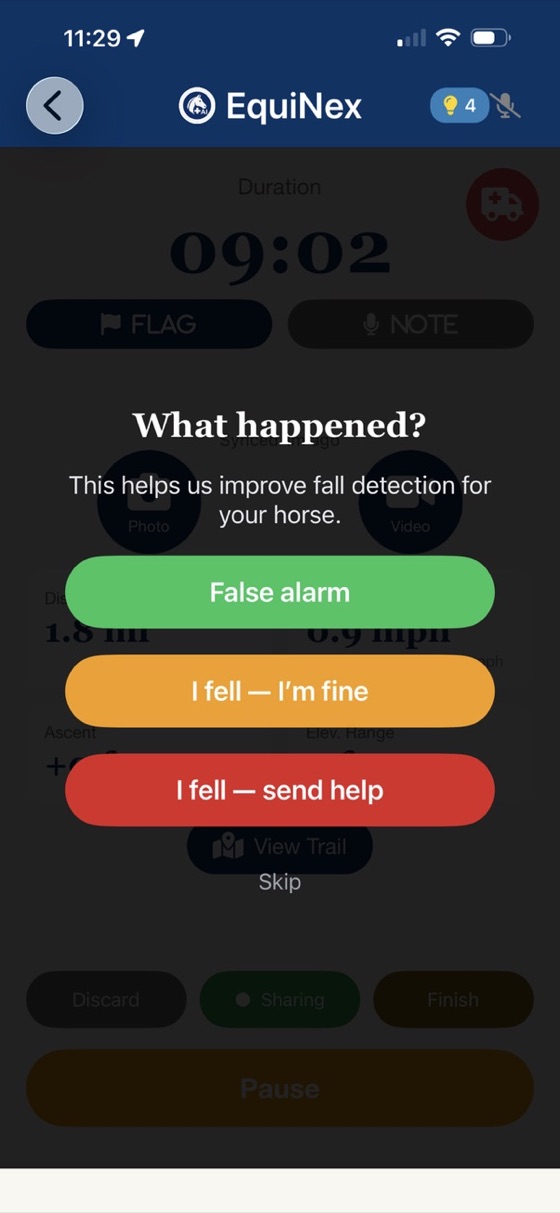
Within seconds, your phone starts asking — out loud — "Are you OK? Tap your phone to respond." It repeats every 30 seconds. If you're fine, one tap ends it. If you don't respond within two minutes, it escalates to a loud alarm for one more minute — a last chance to find your phone and shut it off. If you still don't answer, EquiNex texts and emails your emergency contact your exact GPS location and a live map link. Your contact doesn't need the app — the link opens in any browser. There's also a hold-to-send SOS button for when you're conscious and need help now.
Fall detection that knows your horse
A hot lope on a green Thoroughbred and a trail walk on a 20-year-old Quarter Horse produce wildly different motion. A one-size-fits-all trigger either false-alarms on the first or misses on the second. EquiNex calibrates to each horse you ride — its motion baseline, its quirks — and every ride refines it. When you dismiss a false alarm with "I'm OK," the system learns. That per-horse learning is the heart of where we're taking the product.
Built in different eras
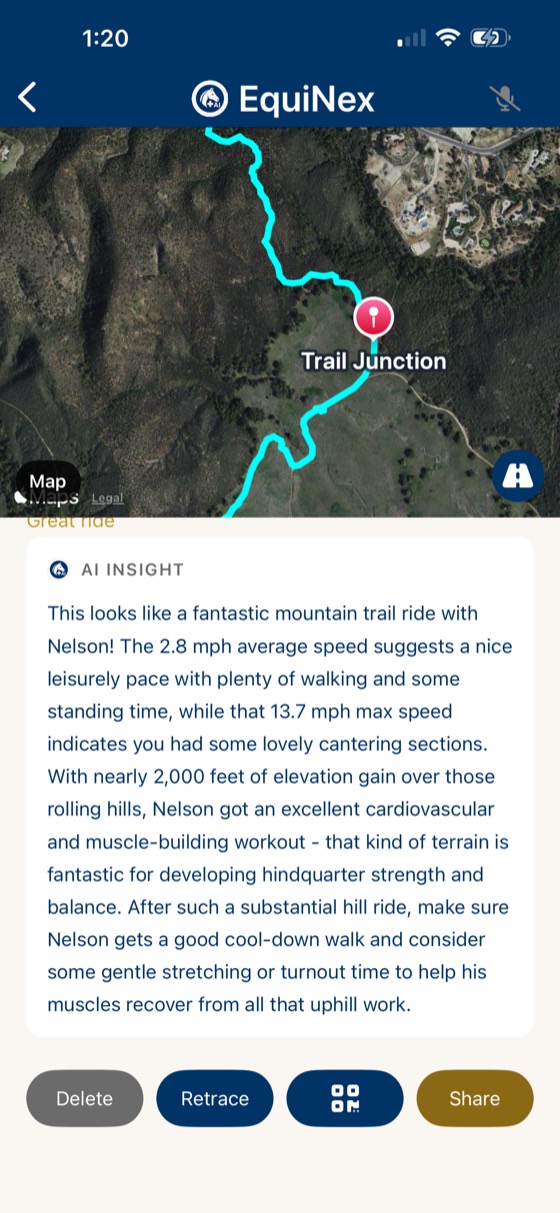
Some of this difference is simply when the two apps were born. Equilab has been building for nearly a decade, and it shows in the polish of a traditional tracker: timers, thresholds, charts of what already happened. EquiNex was built from the ground up in the AI era, around a different premise — that the app should learn your horse. That's why fall detection calibrates to each horse you ride, why the end-of-ride AI insight reads your horse's feed, medical history, and past rides before it says a word — and why per-horse gait analysis, learned from your horse's actual motion rather than fixed speed thresholds, is next on our roadmap. A tracker built before machine learning can add features. It can't easily change its premise.
The trail-rider features that don't have an Equilab equivalent
Beyond the safety core, a list of things EquiNex riders use every week that have no published counterpart on Equilab's feature pages:1
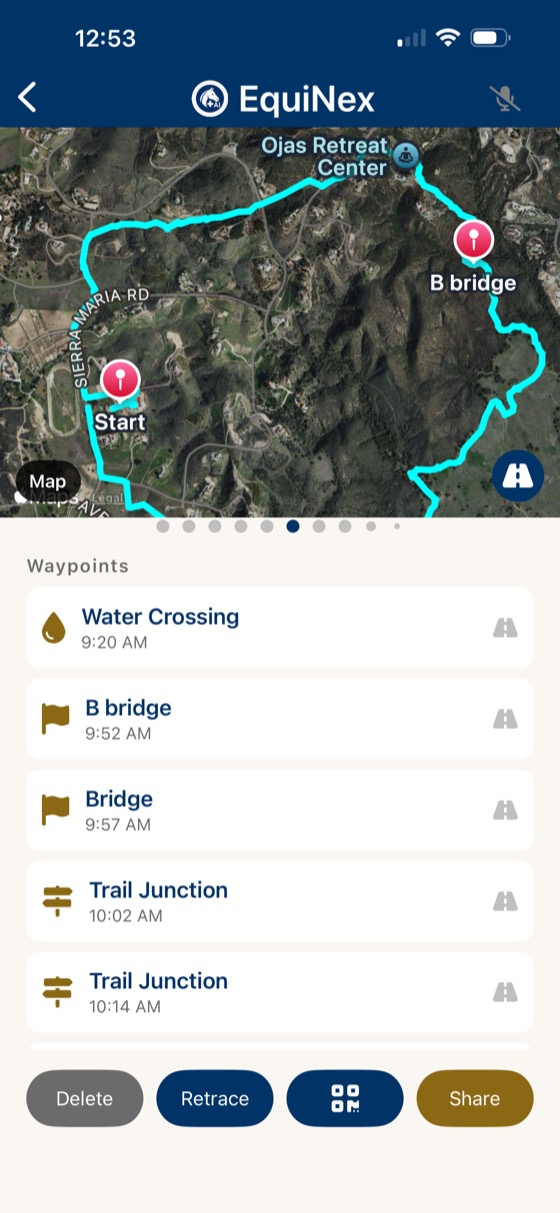
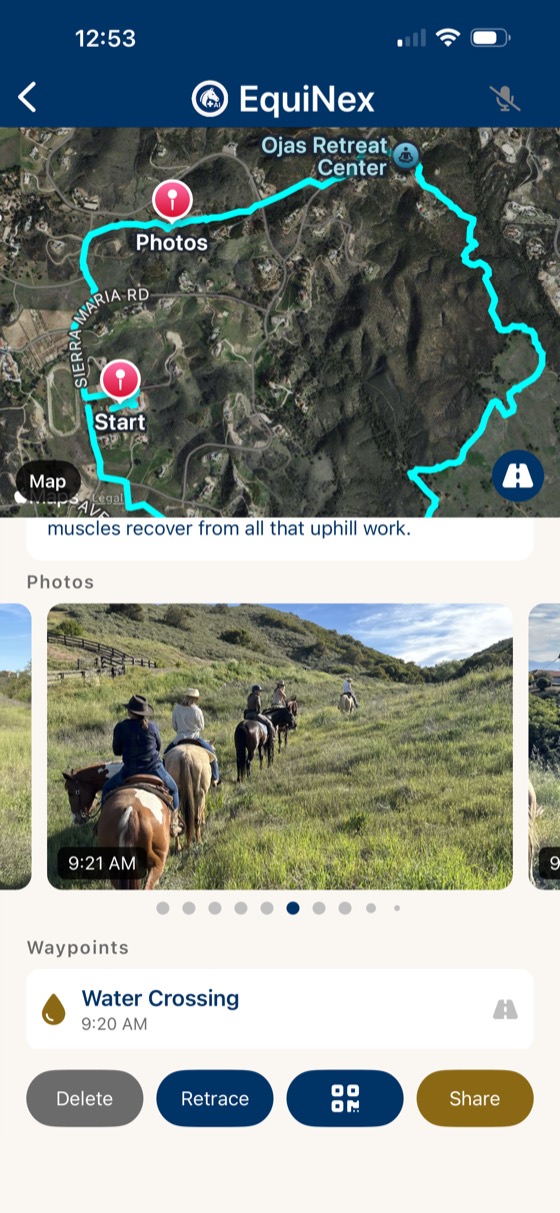
- Trail markers, not just photos. Photos geo-tagged to your route — plus waypoints for the things that matter on a trail: hazards, water crossings, gates, steep sections. Anyone who rides your shared trail sees them.
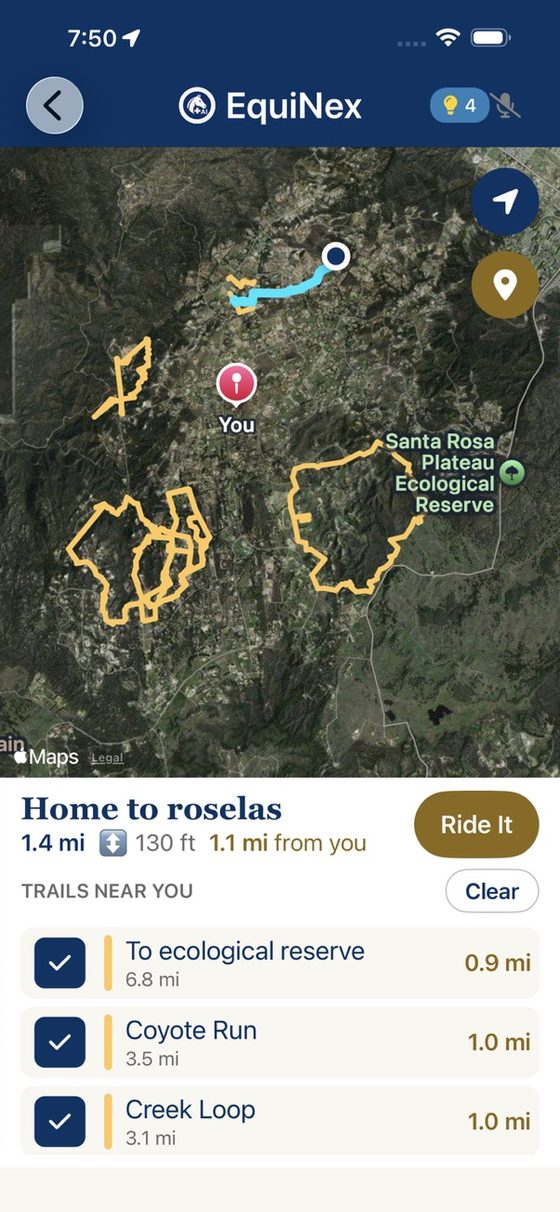
- Trails near you, on one map. Every trail in your library within a mile of where you're standing — including mid-ride, on your live map.
- A crumb trail through dead zones. Lose signal and EquiNex keeps recording, then pushes your breadcrumb the moment coverage returns. The person watching your share page sees where you went — not a track that just stops.
- Group rides with shared memories. Everyone's photos and markers land in the same shared ride record — one ride, the whole group's story. (Equilab offers community groups — a feed for tips and stories — which is a different thing from riding together in one shared, live ride.)
- A permanent link for every ride. The share page outlives the ride: send it to family, post it, keep it. It also exports GPX/KML for SAR and mapping tools.
- Emergency contacts need nothing — and the alert comes to them. No app, no account, no setup on their end: they get a plain SMS and email with a live map link that opens in any browser. Equilab offers a watch-only web link too, but its safety alerts go only to contacts who have the app installed1 — a browser viewer has to be actively watching to notice anything is wrong.
- Retrace any ride or trail — yours or one a friend shared — with the route as an overlay under your live track.
- An AI that actually knows your horse. End-of-ride insights informed by your horse's feed schedule, medical conditions, and ride history — not generic stats.
Don't take our word for it — read their reviews
Browse public reviews and rider forums and three themes about Equilab come up again and again:2
- "Safety" contacts who couldn't see the ride. Reviewers report safety contacts unable to see a ride until after it ended — riders believing they had a safety net that wasn't there. EquiNex's live share updates continuously, buffers through dead zones, and never depends on the ride ending — and if you fall, your contact doesn't need to be watching at all: the SMS comes to them.
- Gait totals that don't match the ride. Riders describe trot-and-canter sessions logged as walking — especially on western pleasure horses, gaited horses, and ponies whose movement doesn't fit the textbook. Equilab's own support docs note the phone must be "secured tightly against your body" for accuracy. This is precisely the one-size-fits-all problem: a fixed motion model fails on horses that don't move like the average. It's why EquiNex's approach — learning each horse's motion — matters, for fall detection today and gait analysis on our roadmap. And it's why EquiNex's fall detection works from a saddlebag, not just a snug pocket.
- Years of rides, newly behind a paywall. Longtime users describe riding history and totals they could always see becoming Premium-only. With EquiNex, ride tracking and your ride history are free — forever. Paid plans add safety and premium features; they never take your own rides hostage.
What Equilab has that EquiNex doesn't (yet)
Fair is fair — a few things on Equilab's published feature list that EquiNex doesn't offer today:1 an Apple Watch app, a real-time audio coach in your headphones, monthly challenges and achievements, community groups, CSV export, and their shipped gait segments with long-term trend analytics. If those are the features your riding revolves around, Equilab earns its Premium price. Our gait analysis — learned per horse — is coming; the rest is a question of what you ride for.
The fairest test: ride with both
You don't have to take our word for any of this. The two apps coexist fine on one phone — start your next rides in both and ask one question at the end of the week: if I'd come off on Tuesday's ride, alone, two miles from the trailhead — what would each app have done for me? We're comfortable with where that comparison lands.
Ride with both for two weeks. Your horse will tell you.
EquiNex is free to download, and ride tracking is free.
Fall detection with emergency alerts is part of our paid plans — current pricing is in the app.
1 Equilab feature descriptions per equilab.horse/features, equilab.horse/premium, and Equilab support: real-time tracking (app-based Safety Contacts receive start/stop/no-movement notifications; the web link is view-only), retrieved July 2026. Equilab is a trademark of its respective owner; EquiNex is not affiliated with Equilab. Review themes per public app-store reviews and rider forums, retrieved July 2026 — e.g. justuseapp.com reviews, Horse & Hound forum, and Equilab's support documentation. Individual experiences vary. 2 Fall detection is a safety aid, not a guarantee — it requires a charged phone, an active ride, and cellular coverage at the moment alerts are sent, and it is not a substitute for riding within your ability, wearing a helmet, or telling someone your route.