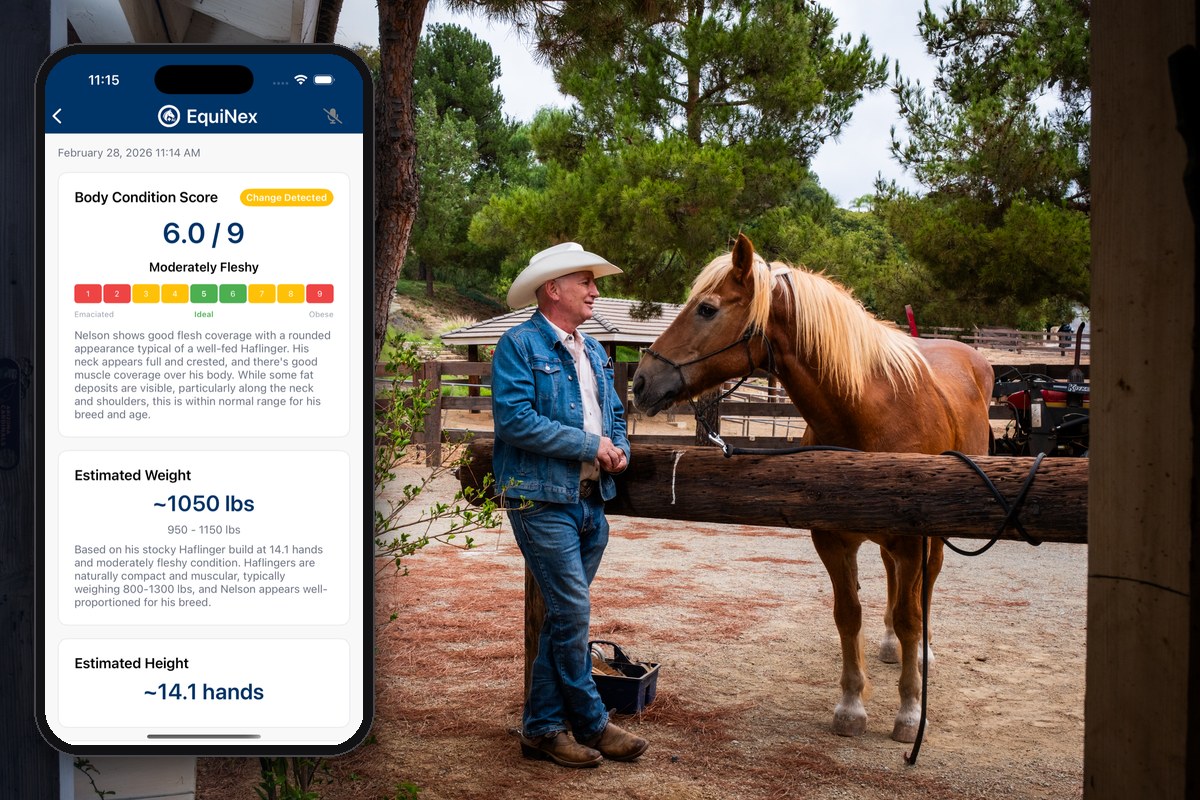
The blanket comes off in March and there he is. A little ribby? Or did the hay belly fool you all winter? You run a hand down his side, step back, squint at his topline and decide he's "about right." That's what you decided last spring too.
That squint is how most of us score body condition. It isn't wrong, but it has two weak spots. Most of us were never shown what to look for or where to put our hands. And "about right" leaves no record, so six months later nobody can say whether it meant a 5 or a 6.
This article covers both: the Henneke scale, in plain terms, and where AI horse body condition scoring from photos fits in next to your own hands.
What body condition scoring is
A body condition score (BCS) is a number for how much fat a horse is carrying. It is not his weight. A 1,100-pound horse can be thin or fat depending on his frame, so the scale reads fat cover instead of pounds.
The standard in the US is the Henneke scale, developed by Dr. Don Henneke at Texas A&M in the early 1980s. It runs from 1 (poor) to 9 (extremely fat), and vets, extension agents and horse rescues all use it. It works on any breed because it asks one question in six places: how much fat is sitting here?
The six places to look, and to feel
Henneke scoring is done with your eyes and your hands. The hands matter more, because a winter coat can hide ribs you would see in July. Stand beside the horse, not behind him, and press firmly but gently. Bone feels hard. Fat feels spongy and gives under your fingers.
| Area | What you are checking |
|---|---|
| Neck | Run your hand along the crest. A thin neck shows its bone structure. A fat one is thick, and the crest can get firm and heavy. |
| Withers | Sharp and standing out on a thin horse. Rounded with fat on either side on a heavy one. |
| Behind the shoulder | A thin horse has a hollow here. As a horse gains, it fills in until the shoulder blends flush into the barrel. |
| Ribs | The most useful single check. Run your fingers across them, not along them. Can you see them? Feel them easily? Have to press to find them? |
| Loin and back | Look down the topline. A ridge means the spine is standing above the muscle and fat. Level is ideal. A crease or gutter down the back means fat is piled up on both sides of the spine. |
| Tailhead | Feel either side of the top of the tail. Bony and prominent on a thin horse, soft at ideal, bulging on a fat one. |
Score each area from 1 to 9 and average the six. That matters more than it sounds. Horses don't put fat on evenly. Some get cresty in the neck while the ribs still feel fine. A high-withered horse can read thin at the withers and nowhere else. Six areas keep one spot from fooling you.
The Henneke scale, 1 to 9
| Score | Name | What it looks and feels like |
|---|---|---|
| 1 | Poor | Emaciated. Spine, ribs, hip bones and tailhead stand out sharply. No fat to feel anywhere. |
| 2 | Very thin | A trace of fat along the base of the spine. Ribs, hips and tailhead still prominent. |
| 3 | Thin | Ribs easy to see with a little cover. Tailhead prominent. Neck and withers look sharp. |
| 4 | Moderately thin | Faint outline of the ribs. A slight ridge down the back. Some fat at the tailhead. |
| 5 | Moderate | Back is level. Ribs can't be seen but are easily felt. Tailhead starting to feel spongy. Withers rounded. |
| 6 | Moderately fleshy | May have a slight crease down the back. Fat over the ribs feels spongy. Fat starting along the withers, behind the shoulder and on the neck. |
| 7 | Fleshy | You can feel individual ribs, but there is fat filling between them. Tailhead soft. Crease down the back likely. |
| 8 | Fat | Clear crease down the back. Ribs hard to find. Neck thick. The area behind the shoulder is filled flush. |
| 9 | Extremely fat | Obvious crease. Bulging fat at the tailhead, withers, shoulder and neck. Flank filled in. |
A quick first sort: if you can see ribs, he is a 4 or below. If you can't see them but can feel them without digging, he is around a 5. If you have to press to find them, he is a 6 or more.
For most pleasure and trail horses, 5 is the target and 4 to 6 is a healthy range. Hard-working performance horses often sit nearer 4. Broodmares are usually kept at 5 to 6.
Where the eye goes wrong
- The winter coat. Hair hides ribs and hip bones. From November to April, score with your hands.
- The hay belly. The belly is not one of the six areas. A big gut is mostly fill, not fat. Plenty of horses carry a round belly under a thin topline, and the belly is what the eye goes to first.
- Seeing him every day. A horse that drops half a point over a winter looks the same from one morning to the next. The change shows up all at once, usually when someone who hasn't seen him in a while says something.
- Two people, two numbers. Ask two people at the same barn to score the same horse and you will often get different answers. One person scoring the same way every time is worth more than a perfect number once.
When the number is a reason to call the vet
A score doesn't tell you why. Teeth, worms, workload, feed, age and illness can all move it, and sorting that out is a conversation with your vet.
- A 1 or 2 needs a vet soon, and a careful refeeding plan.
- An 8 or 9 is also worth a vet visit. Excess fat is tied to insulin problems and laminitis.
- A crest that turns hard, or keeps growing, is worth mentioning even if the rest of the horse looks fine.
- So is a change of a full point or more that you can't explain with feed or work.
Where AI horse body condition scoring fits
None of this needs an app. Six areas, your hands, a note on the calendar once a month. The trouble is that almost nobody keeps doing it, and nobody remembers what they decided in October.
That is the gap a photo score fills. EquiNex has a Health Photo Check. You take up to four photos of the horse (left side, right side, front and rear) and it gives back a Henneke score from 1 to 9, in half points. With the score comes an explanation of the areas it looked at, such as the ribs, withers and tailhead, so you can see why it landed where it did.
The same photos give an estimated weight, shown as a range, an estimated height in hands, and a conformation assessment by body area. Treat the weight as a ballpark, not a scale reading.
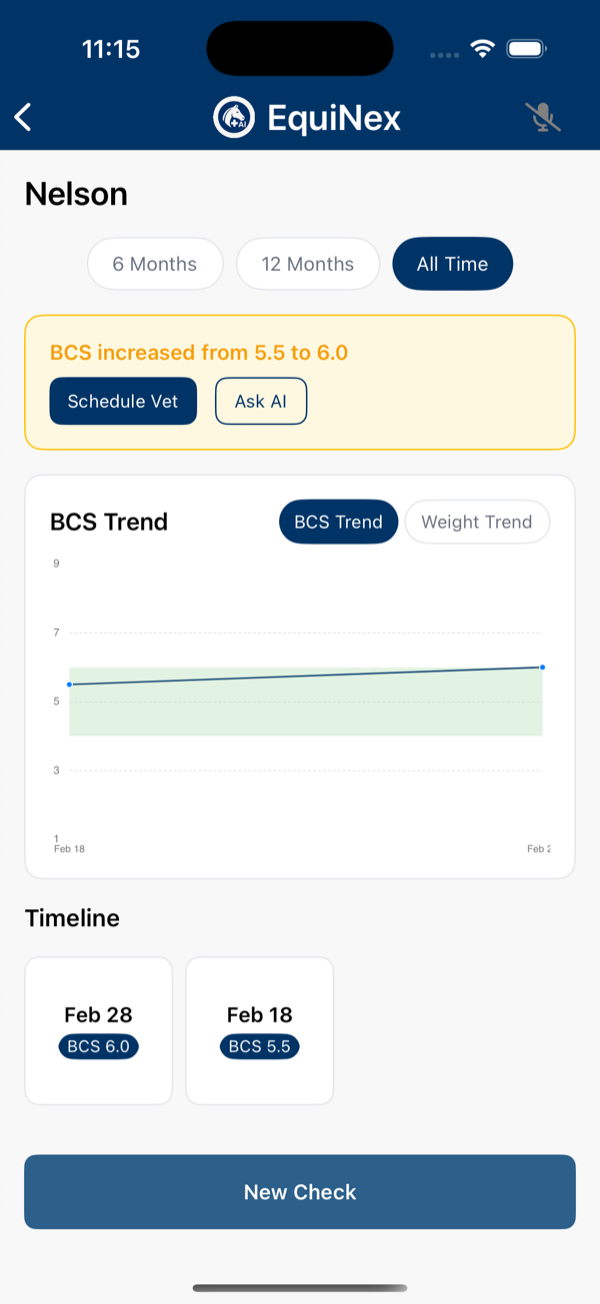
Every check is saved, with history and trend charts over time. One score tells you where he is today. The line over six months shows the winter slide, the spring-grass climb, or the old horse who holds his weight until one season he doesn't.
Now the limits of AI horse body condition scoring. A photo can't feel through a winter coat. Bad light, a horse standing crooked or a thick coat can all throw it off. It is informational, not a veterinary evaluation, and it doesn't replace your hands. Use it the way you would use a second opinion from someone who scores the same way every time and writes it down.
The score sits with the rest of the horse's care record. When your vet comments on condition at a visit, type it into the appointment notes. The AI consultant reads those notes, so "What did the vet say about his weight last time?" gets an answer. (More on that in a horse veterinary records app you can just ask.)
Check your eye for free
There is a free body condition tool at bcs.equinexai.com. No login, no account. A good way to use it: score your horse by hand first, using the six areas above, and write the number down. Then take the photos and compare. If the two disagree, go back and feel the area it points to.
In the app, the free plan includes a small number of AI analyses, and paid plans include more each month.
Three habits that take a minute
- Hands on the ribs and tailhead once a month. More often in blanket season and on spring grass.
- Photos from the same spot each time: level ground, horse standing reasonably square, side-on for the side shots.
- Write the number down, or let the app keep it.
Your horse can't tell you he has been losing weight since November. By the time it is obvious from the feed room, it has been going on for a while, and half a point is always easier to fix than two. Know the six places, put your hands on them, and keep the number somewhere you can find it.
The scale is from Henneke et al., Texas A&M, 1983. For illustrated charts of each score, see the Association for Pet Obesity Prevention's horse BCS page and the University of Georgia Extension guide.