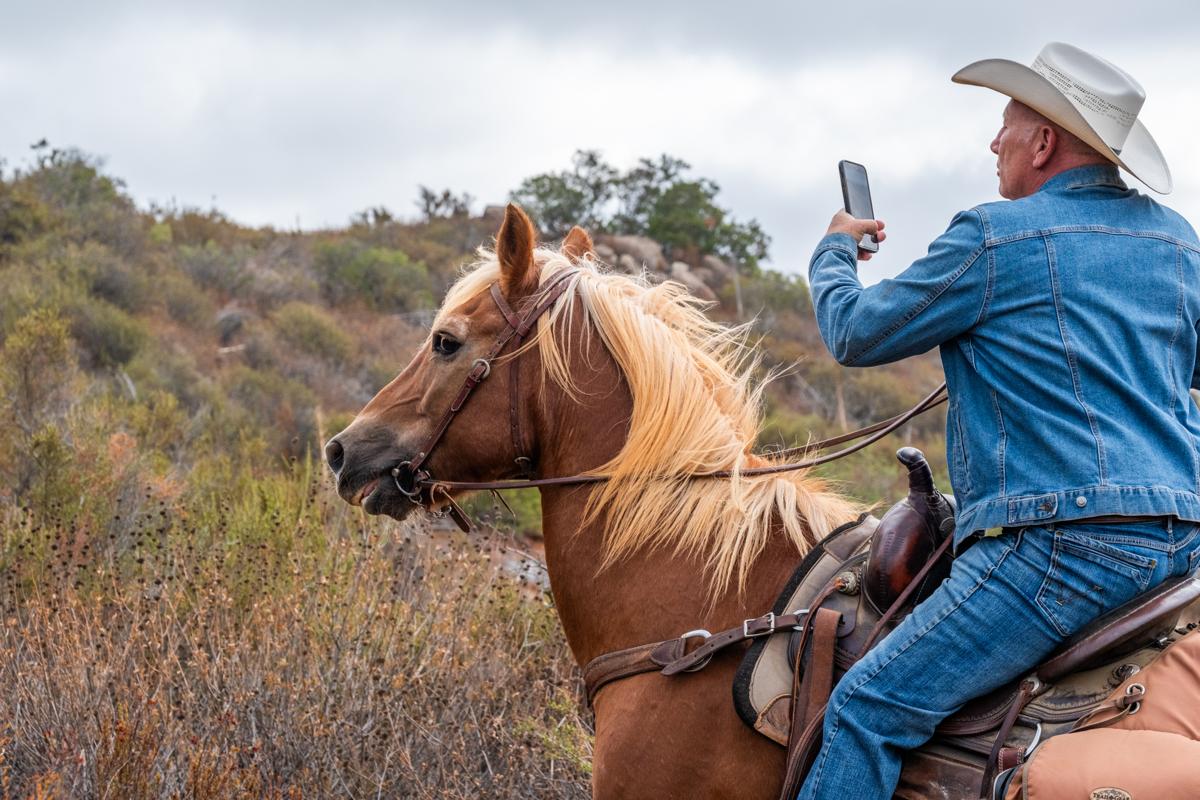
You're two ridges past the last bar of signal when your horse spooks at a deer and you hit the ground. Your phone still knows exactly where you are. The question is whether anyone else will find out.
Riders tend to lump three different things together as "my phone works out there": GPS, cell signal and satellite communication. They do very different jobs, and each one quits in a different place. Knowing which is which tells you what you can count on when a ride goes wrong.
Does GPS work on off-grid trails? Yes. It just can't tell anyone.
GPS: knowing where you are
Every smartphone has a GPS receiver. It listens to satellites overhead and works out your position, and it doesn't need cell signal to do it. As long as you let your riding app use your location, your phone can record your route in the middle of nowhere.
GPS only listens, though. It never transmits, so it can't send your position to anyone. And it needs a reasonably open view of the sky. In a deep canyon or under heavy timber, the position gets less accurate and the track can wander. It still works, just less precisely.
Cell signal: telling someone
Cell signal is the two-way link. Anything that has to leave your phone needs it: a call, a text, a live location, an emergency alert. On a trail it comes and goes with every ridge and valley. Two bars at the trailhead can turn into nothing a mile in, and back to one bar on the next hilltop.
Satellite communication: the backup channel
Satellite messengers such as Garmin inReach, ZOLEO and SPOT devices send messages and SOS calls through satellites, where there's no cell coverage at all. Newer phones, the iPhone 14 and later and some recent Android models, can send an emergency SOS by satellite too.
That's a real advantage in remote country. But these tools come with trade-offs. They need a clear view of the sky, so a canyon or thick canopy can delay them. A messenger is one more device to carry and charge, usually with its own subscription. You have to press the button or start the SOS yourself. And none of them is built for horseback riding: they don't know you came off your horse unless you tell them.
That gap is starting to close. Cell carriers have begun adding satellite texting to ordinary phone plans (T-Mobile with Starlink is one example), and others are working on it. When a regular phone can send a message by satellite, that's one more way for an EquiNex alert to get through, and we intend to put it to work as soon as it's available.
No perfect answer, only trade-offs
GPS knows where you are but can't tell anyone. Cell signal can tell people, but not everywhere. Satellite works almost everywhere, but needs sky, gear and a free hand. Every rider's setup is some mix of the three, and it helps to know where each one stops. That's why "does GPS work off grid trails?" is only half the question. The other half is who hears about it.
What this means when you come off
This is where it stops being theory. EquiNex's horseback fall detection runs on the phone, so detecting a fall and sounding the alarm work with or without signal. Sending the alert to your emergency contacts needs signal, and it goes out as soon as there is some. How that plays out depends on where you are and where the phone ends up.
You're down, the phone is with you, and there's no signal
This is the hard one. The phone knows where you are and has detected the fall, but it can't call anyone, and neither can you. The alert waits for signal. If you can move toward a hilltop, it goes out when you get there. If you can't move, a satellite SOS, if you carry one and can reach it, is the only thing that reaches out from there.
Spotty signal, and your horse leaves with the phone
Now picture the phone in the saddlebag and your horse heading for home without you. EquiNex keeps the location where the fall was detected, even as the horse keeps moving. If he carries the phone into an area with signal, the alert goes out to your emergency contact with the spot where you came off, not just where the horse ended up.
Good signal, but the horse has the phone
The flip side: you're in coverage, but your phone is leaving with your horse. You can't reach it to cancel the alarm or to call for help. But if your horse took off without you, chances are you need help anyway, and the alarm will send the message. The catch: the map is with the horse too, and so is your only way to tell your contacts you're OK, or to talk the situation through with them.
EquiNex works wherever you carry the phone. Each choice has its own trade-offs, and now you know what they are.
What your contact sees while you're out of range
If you're sharing your ride, your contact's live page doesn't just freeze. When your phone loses signal, it tells them you're likely out of cell reception and keeps your last known position on the map. It shows your battery level too. Flags and photos you add while out of range are held and sent automatically when signal comes back, and when you end the ride, your contact gets a message that you're done.
One honest limit: EquiNex can also alert your contact when a live-shared ride goes silent after a hard impact, but only if the phone had signal when the impact happened. With no signal at all, the phone is on its own until it finds some.
What's worth doing
- Leave with a charged phone, and bring a backup battery on long rides.
- Start the ride before you leave the trailer, while you still have signal, so your contact gets the live link.
- If you often ride far beyond coverage, a satellite messenger is a sensible second layer. It covers the gap your phone can't.
So, does GPS work on off-grid trails? It does, and it'll faithfully record every step of the ride. What decides whether help comes is the link back to the people who care where you are. Know which link you have, where it ends, and what your phone will do on its own when it can't reach anyone.