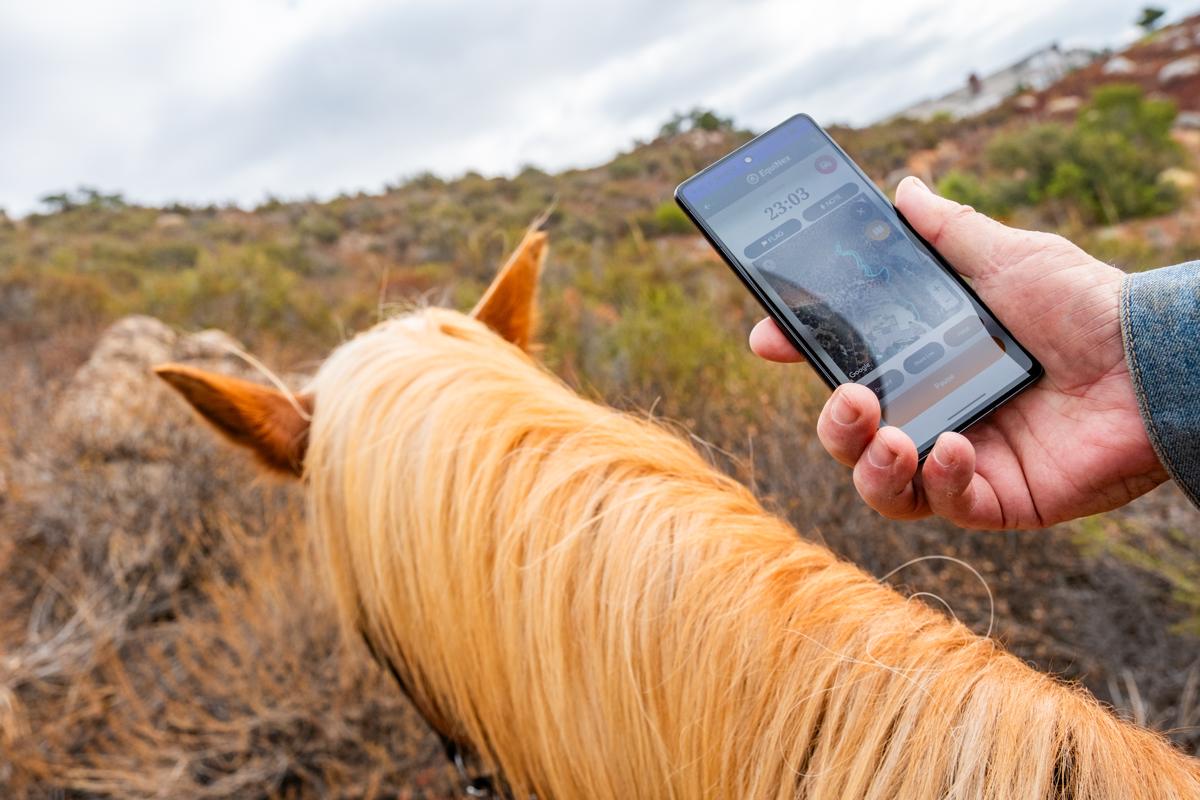
It's the first warm Saturday in April. Your horse stood around most of the winter, and you're about to ride the twelve-mile ridge loop you finished easily last October. He feels fresh. You feel fresh. Nobody asks whether his legs remember October. A horse conditioning tracking app is supposed to answer that question, but it can only help if you know what you're tracking and why.
Most of us don't follow a conditioning program. We ride when we can, as far as the day allows, and judge fitness by feel: "he was blowing on the hill," "he seemed fine." That isn't wrong. Feel matters. But it has a short memory.
So this article covers how conditioning actually works first, the part you can use with no app at all. Then it covers what's worth letting your phone remember for you.
Why "by feel" falls short
Ask a rider how much their horse did last month and you'll usually get a guess. "Three or four rides a week, I think. Mostly the short loop." Then a busy stretch at work turns three rides a week into one, and nobody notices until the horse is puffing on a hill he used to walk up easily.
Memory also flattens the details. You remember the long ride, not the two weeks of nothing before it. You remember "we trotted a lot," not that the trotting was all downhill on hard ground. And you almost never remember how long the horse took to settle afterward, which is the number that tells you the most.
The bigger problem is that how the horse feels and how ready his body is are not the same thing.
How conditioning works: different systems, different clocks
Conditioning means making a horse fit for the work you ask of him by adding work gradually and letting his body adapt between rides. The basics have been well established for decades. Hilary Clayton's Conditioning Sport Horses (1991) laid them out, and university extension services repeat them in their guidance. The key point: a horse's body systems adapt at very different speeds.
| System | Roughly how fast it adapts | What you notice |
|---|---|---|
| Heart and lungs | Within weeks | Less blowing, faster recovery after a climb |
| Muscles | One to three months | More stamina, a stronger topline and hindquarters |
| Tendons, ligaments, bone | Several months, often cited as six or more | Nothing, until something goes wrong |
That last row is the trap. After a few weeks of riding, your horse breathes easily and feels ready for more. His legs aren't. The horse that "felt great" on the long April ride is the one that comes up sore or with a warm tendon a week later. Building slowly isn't about his wind. It's about the parts you can't feel from the saddle.
Build the base at a walk
A horse coming back from time off starts with walking: twenty to thirty minutes, several days a week, on good footing. Walking builds bone and tendon strength with little risk. Over a few weeks, the walks get longer, then short trot sets are added, then hills. Experienced trail and endurance riders call this "long slow distance," and it's the foundation of everything else.
Change one thing at a time
You can make work harder in three ways: longer, faster, or steeper. Add one at a time, and only once the horse handles the current level well. A common rule of thumb is to increase total weekly work by no more than about ten percent. If you add miles this week, don't also add speed.
Use hills, slowly
Walking up hills is one of the best conditioning tools a trail rider has. It builds the hindquarters and back with far less pounding than speed work on the flat. Downhills are harder on the front legs and tendons, so take them slowly, especially early in the season.
Rest is part of the program
Adaptation happens between rides, not during them. Most programs include at least one or two easy or off days a week. A horse ridden hard every day just gets tired.
How to check fitness with your own hands
You don't need equipment to know whether your horse is getting fitter. You need three numbers and a watch.
- Pulse. Feel for the artery that runs under the jaw, on the inside edge of the lower jawbone, or listen with a stethoscope just behind the left elbow. Count for 15 seconds and multiply by four. Most adult horses rest at roughly 28 to 44 beats a minute.
- Respiration. Watch the flank or a nostril. One in and one out counts as one breath. At rest, most horses breathe roughly 8 to 20 times a minute.
- Temperature. A normal rectal temperature is about 99 to 101°F.
Learn your horse's resting numbers on a quiet day, because horses vary. Then the useful part: check his pulse 10 minutes after a hard stretch, such as the top of a long climb. A fit horse working at a moderate level usually drops to around 60 to 64 beats a minute within that time. Endurance rides use a similar threshold at their vet checks. If your horse's numbers come down faster on the same climb in May than they did in April, he's getting fitter. We go further into this in how to measure horse recovery without a heart rate monitor.
Where people go wrong
- Comparing different rides. A recovery check only means something on the same hill, at roughly the same pace and in similar weather.
- Ignoring heat. A widely used extension rule: add the temperature in °F to the relative humidity. Above 150, take care. Above 180, a horse struggles to cool itself, so cut the work back hard.
- Riding to the calendar instead of the horse. If he's off, stiff or unwilling, the plan waits.
When to call the vet
Call your vet if the pulse stays high long after work, if breathing stays fast or becomes faster than the pulse, or if the horse won't drink or eat after a ride. Also call for muscle stiffness, sweating and reluctance to move during or after work (signs of tying up), dark urine, or any lameness or new heat and swelling in a leg. These need a professional, not more data.
What a horse conditioning tracking app should remember for you
Everything above works with a notebook. The trouble is that almost nobody keeps the notebook. This is where a horse conditioning tracking app earns its place: it records the part you would forget, without asking you to write anything down.
With EquiNex, you start a ride and put the phone away. It records the route, distance, time and elevation, with or without cell signal. Afterward you see distance, duration, average and max speed, elevation, and a map with a replay scrubber. A short AI "ride insight" comments on how intense the ride was and gives one conditioning or recovery tip.
EquiNex also builds a gait timeline (walk, trot, canter, halt) from the phone's motion. That's the "we trotted a lot" detail made honest, and you can correct it if it got something wrong. (The gait timeline is part of the paid plans after the first day.) Over time, each horse gets training insights: a ride heatmap, the share of time spent in faster gaits, and personal records such as the longest ride, top speed and longest canter.
For recovery checks, consistency matters, and saved trails help here. Save your benchmark loop as a trail with one tap, then retrace it with the reference route drawn on the map. Your test hill stays the same hill every time.
The rides sit next to the horse's care record, and the AI consultant can see the last 30 days of them. "How much has Nelson done this month?" gets a straight answer instead of a guess. It also reads the horse's notes, so if you type "pulse 60 at ten minutes on the ridge climb, felt strong," that becomes part of the record you can ask about later. It answers only from what's in the app, so it's only as good as what gets recorded.
To be clear about the limits: EquiNex does not measure heart rate and doesn't give a recovery score. Your hands and a watch still do that part. If your horse is carrying too much or too little weight going into the season, the Health Photo Check gives an estimated Henneke body condition score and weight from photos, with a trend over time. It's informational and no substitute for your vet's eye.
The few habits worth keeping
- Start the ride in the app every time, even the short loop. The short rides are the ones memory drops.
- Pick one benchmark hill and take a pulse at the top, 10 minutes after you stop, now and then.
- Type one line into the horse's notes when something is different: stiff, sluggish, unusually strong.
That's it. No spreadsheets, no training diary.
Conditioning is mostly patience. The heart and lungs get fit fast, and that fools us into asking the legs for more than they're ready for. Knowing what your horse has actually done, instead of what you think he did, is how you keep him sound into his twenties. It's also how you avoid the phone call to the vet in May.
No app can feel a warm tendon. But when you run your hand down his leg after the ride and something feels different, you'll know exactly what he did that week, and so will your vet.