You're two hours from home at a clinic when the phone rings. It's the neighbor's kid, who is feeding tonight. "Does the bay get the senior feed or the pellets? And how much is a scoop?"
Your horse feed schedule is perfectly clear. It just lives in your head. You feed the same horses at the same times every day, and you could do it in the dark. You probably have, in January.
That works fine as long as you're the one feeding. Most horses get fed by someone else sooner or later: a spouse, a barn friend, a neighbor's kid, the person covering while you're sick. That's when "the usual" turns out to mean something different to everyone.
Why the feed room whiteboard isn't enough
Most barns have some written version. A whiteboard in the feed room, a sheet taped inside the bin lid, a note on the fridge. Look closely and part of it is crossed out from last winter, and the supplement your mare started in May isn't on it.
The bigger problem is the units. "One scoop" means nothing to someone who doesn't know which scoop. A coffee can of pellets and a coffee can of sweet feed or oats don't weigh the same. "Two flakes" might be 6 pounds or 14, depending on the bale. And the reasons behind the schedule (the vet said cut the grain when he went out on grass, the old gelding gets soaked cubes because of his teeth) are usually written nowhere.
So before getting to who reads the schedule, it's worth making sure the schedule itself holds up.
Horse feed schedule basics, from the extension guides
None of this is new. Most of it comes from the National Research Council's Nutrient Requirements of Horses (2007) and the university extension guidance built on it (Penn State, the University of Minnesota, Rutgers and others publish good free summaries). Your vet or an equine nutritionist adjusts it for your horse. Here are the fundamentals.
Forage first, by weight
A horse is built to graze for most of the day. Its stomach is small and produces acid all the time, whether there's food in it or not. That's why forage (pasture, hay, hay cubes or hay pellets) is the base of any feeding plan, and grain is the add-on.
The general guidance: a horse eats about 1.5 to 2.5 percent of its body weight in total feed per day, and forage should be at least 1 percent of body weight, with most horses doing best at 1.5 to 2 percent. For a 1,000-pound horse that means roughly 15 to 20 pounds of hay a day if it has no pasture.
To use those numbers you need two weights: the horse's and the hay's. For the horse, a weight tape or a formula gets you close enough (here's how to estimate horse weight from a photo, tape or formula). For the hay, hang a cheap luggage or fish scale in the barn and weigh a few flakes from the current load. Do it again when a new load comes in. Weigh one level scoop of each concentrate while you're at it. You'll only do this a few times a year, and it turns "two flakes and a scoop" into pounds.
Grain: small meals, slow changes
Many horses in light work on decent hay need little or no grain. A ration balancer often covers the vitamins and minerals hay lacks. When a horse does need concentrate, meal size matters more than most people think.
The common extension rule is no more than about 0.5 percent of body weight in concentrate per meal: about 5 pounds for a 1,000-pound horse. A big starchy meal can overflow the small intestine and reach the hindgut, where it ferments. That's linked to colic and laminitis. If a horse needs more, split it into two or three meals rather than making one meal bigger.
Change feeds gradually, over roughly 7 to 14 days, mixing in more of the new feed each day. That includes hay. A new load from a different field or cutting is a feed change, so blend it with what's left of the old load for a week if you can.
Timing, water and salt
Horses learn feeding times fast, and a consistent routine matters more than the exact hour. The longest stretch without food is usually overnight, so the evening feed is the place for the biggest share of hay. A slow feeder net helps stretch it out. Long gaps with no forage are tied to gastric ulcers.
For riding: a horse that has been eating hay is fine to ride. After a grain meal, many guides suggest waiting an hour or so before hard work.
Here's what the guidance works out to for a 1,000-pound adult horse at maintenance or light work. Treat it as a starting point and adjust to body condition, work and the vet's advice.
| Item | General guidance | For a 1,000-lb horse |
|---|---|---|
| Total feed | 1.5–2.5% of body weight a day | 15–25 lb |
| Forage | At least 1%, usually 1.5–2% | 15–20 lb hay with no pasture |
| Concentrate per meal | No more than about 0.5% | 5 lb max per meal |
| Feed changes | Gradual, about 7–14 days | Including a new hay load |
| Water | Clean, always available | Often 5–10 gallons at rest, far more in heat or work |
| Salt | Free-choice block or loose salt | Roughly 1–2 oz a day |
The other half of the equation is the horse. Run a hand along the ribs, behind the shoulder and over the tailhead every few weeks. If you can't feel the ribs at all, or you can see them clearly, the schedule needs adjusting. The Henneke body condition scale (Texas A&M, 1983) gives you a 1 to 9 way to put a number on it; we explain how in horse body condition scoring and the Henneke scale.
Where it goes wrong, and when to call the vet
The mistakes are ordinary ones:
- Feeding by volume instead of weight, so the ration quietly changes when the feed or the scoop changes.
- Feeding the easy keeper what the hard keeper gets, because they eat side by side.
- Doubling a supplement because two people both thought it was their job.
- Switching hay loads overnight.
- Letting grain do the work hay should be doing.
Call the vet when a horse leaves its feed, shows colic signs (pawing, rolling, looking at its flank, no manure), drops balls of half-chewed hay, or loses weight while eating normally. Call before big diet changes for a horse with a metabolic or laminitis history, and before turning one onto spring grass. A feeding schedule supports your vet's advice. It doesn't replace it.
What EquiNex does with the feed schedule
EquiNex doesn't decide what your horse should eat. It makes sure the plan you and your vet settled on gets to whoever is feeding tonight.
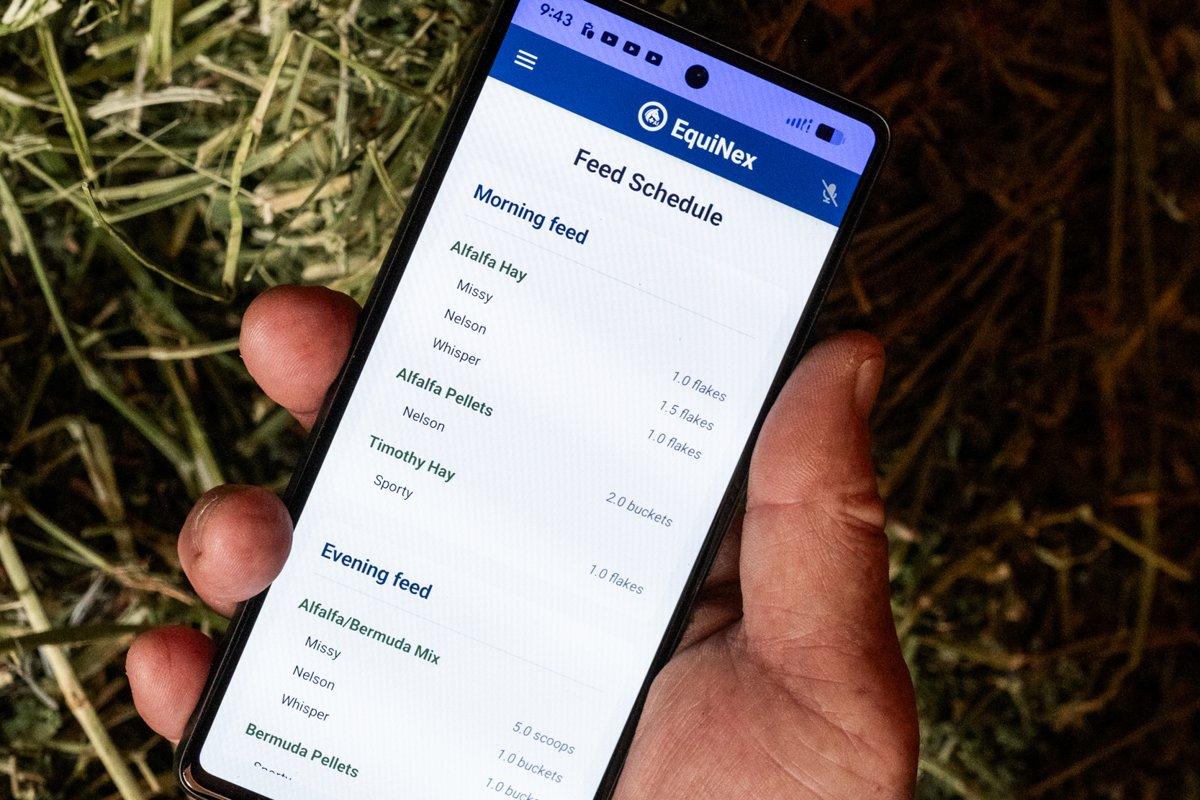
Each horse gets a feed plan by time slot (morning, midday, evening), with the feed type and amount for each, supplements included. Write "4 lb senior feed" instead of "one scoop," and the neighbor's kid doesn't have to call.
The barn-wide feed report groups every horse's feeds by time slot. It's the "who gets what" sheet for whoever is feeding, and it's never the version from last winter. Invite your helpers to the barn by QR code, link, text or email, and everyone on the team sees the same horses, schedules and records. (We compare this with the clipboard in barn app versus paper binders.)
The reasons can go in too. Type "vet said cut grain to 2 lb while on grass" into the horse's notes, and the AI consultant can see it, so asking "What did the vet say about his feed?" gets you an answer. It's only as good as what gets written down, the same as paper.
A few related tools fit in. Health Photo Check gives an estimated weight with a range and a Henneke body condition score from photos, with history over time. That's useful when you're working out pounds of hay, but it's informational and not a substitute for your vet's evaluation. Barn tasks, with a template library for feed and supplements, can be assigned to a team member and record who completed them and when.
To be clear: EquiNex has no feeding reminders. It won't ping anyone at 6 PM to feed. It keeps the plan in one place where everyone can see it. More on the horse care records.
Three habits that take seconds
- Write amounts in pounds, not scoops or flakes, once you've weighed them.
- When the ration changes, change the written plan the same day, and add a word about why.
- When a new hay load arrives, weigh a couple of flakes before you feed it.
That's all. No feed logs, no daily spreadsheets.
A good horse feed schedule is mostly about the horse: steady forage, sensible meals, slow changes. But a schedule only works if the person holding the scoop can follow it. Your horse doesn't know you're at a clinic two hours away. It only knows whether dinner looks like it always does.
Write it down so it means the same thing to everyone, and the evening the neighbor's kid feeds is just another evening.