The dewormer tube is in your hand. The plunger dial goes up by body weight, and you're about to set it from a number you came up with a few years ago, when your horse was younger, fitter, or just a different shape.
Most of us don't weigh our horses. Ask what he weighs and you'll get a confident answer: "about eleven hundred." Somebody guessed once, maybe the seller, maybe the vet at a spring visit, and that guess became his weight. The horse changes. The number doesn't.
There are four practical ways to get a better one: a scale, a tape measure and a formula, a weight tape, and now your phone, since you can estimate horse weight from photo shots. Here is how each one works and how far to trust it.
Why the number matters
- Dewormers and medications are dosed by weight. Guess low and he gets less than a full dose, and under-dosing dewormers is one of the things that helps parasites become resistant. Your vet doses by weight too, and will ask.
- Feed is figured from weight. A common starting point is 1.5 to 2 percent of body weight per day in forage. For a 1,000-pound horse that is 15 to 20 pounds of hay. Be off by 150 pounds on the horse and you are off by a couple of flakes a day.
- Change is the early warning. Twenty pounds a month on summer grass doesn't show from one morning to the next. Neither does an old horse slowly dropping weight over a winter. You notice when the cinch goes up two holes.
Four ways to get a weight, best to worst
1. A scale
A livestock scale is the only real measurement. Many vet clinics have one, and some feed stores and fairgrounds do too. If you ever haul somewhere with a scale, walk him across it and write the number down. It gives you something to check every other method against.
2. A tape measure and the formula
This is the method extension services teach, and it needs nothing but a soft tape measure at least 75 inches long. Take two measurements, in inches:
- Heart girth: all the way around the barrel, just behind the elbows and over the highest part of the withers.
- Body length: from the point of the shoulder straight back along his side to the point of the buttock.
Then: heart girth × heart girth × body length ÷ 330 = weight in pounds.
A horse with a 75-inch girth and a 68-inch body comes out at 75 × 75 × 68 ÷ 330, or about 1,160 pounds.
A few things make it work better. Stand him reasonably square on level ground. Have someone hold him instead of tying him, and a second pair of hands helps with the length. If you are tracking change, measure at the same time of day, ideally in the morning before he eats. The formula is less reliable for pregnant mares and for horses with unusual conformation.
3. A weight tape
The weight tape from the feed store is the same idea with half the information. It reads heart girth only and assumes an average body length. That makes it quick, and it makes it wrong for horses that are long or short for their height. It is still useful for one thing: used the same way, in the same spot, it shows whether he is going up or down.
4. Your eye
The eye is the least reliable of the four, and it is the one most of us use. Extension guides say plainly that the formula beats a visual guess. The eye also has the everyday problem: you see him every morning, so slow change is invisible.
Where it helps to estimate horse weight from photo shots
A photo estimate is an eye, but a consistent one that keeps a record. It doesn't replace the tape. What it does is put a number down on the days you were never going to get the tape out.
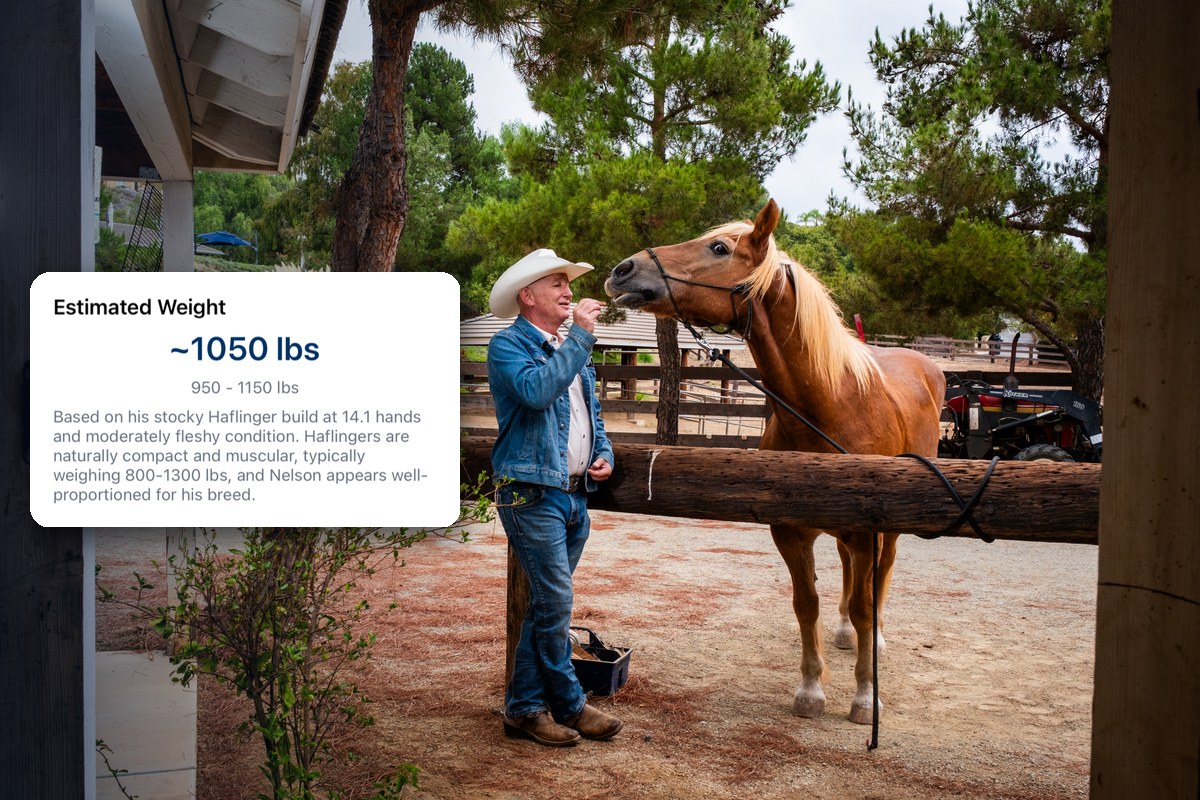
EquiNex has a Health Photo Check. Take up to four photos (left side, right side, front and rear) and it gives an estimated weight, shown as a range instead of one number pretending to be exact. In the example below the estimate is about 1,050 pounds, with a range of 950 to 1,150. That range is the honest part: a photo is not a scale.
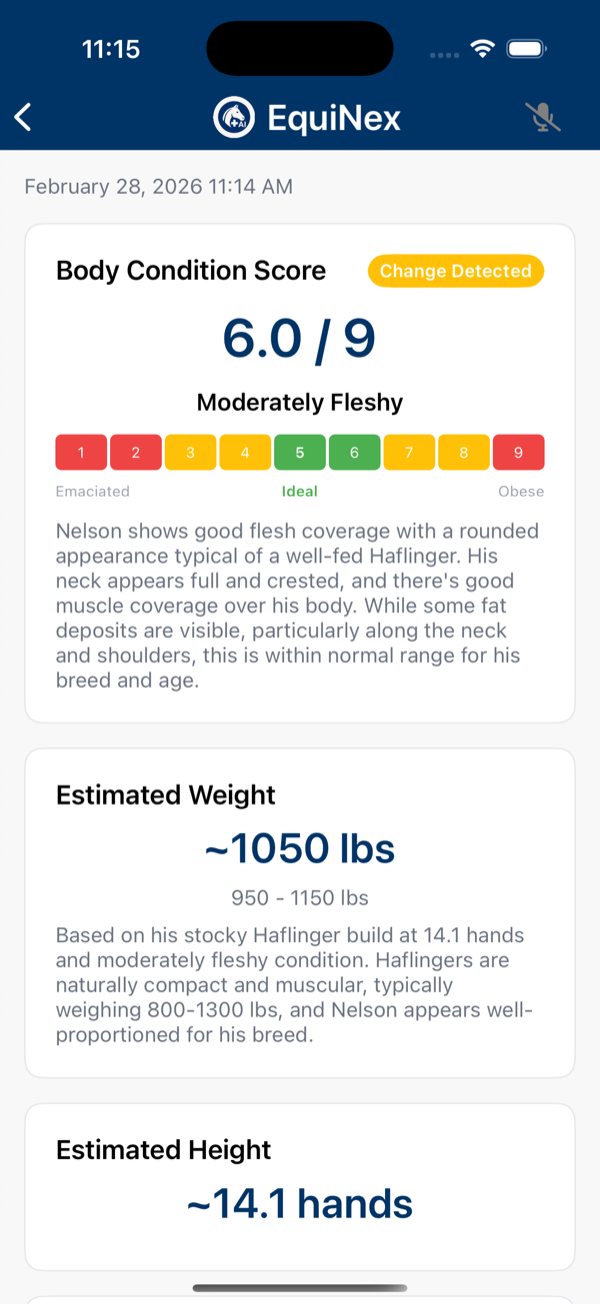
So use it for what it is good at. For a dewormer or a medication dose, use the formula or a scale, and ask your vet if you are between marks on the tube. For "is he gaining or losing?", a photo check every month or two is plenty, and every check is saved with history and trend charts, so the change you couldn't see day to day shows up as a line.
The same check gives a Henneke body condition score from 1 to 9, an estimated height in hands, and a conformation assessment by body area. The condition score matters as much as the pounds. Two horses at the same weight can look completely different, one fit and muscled, the other soft with fat over the tailhead. Weight tells you how much horse there is. Condition tells you whether that is the right amount for him. (We explain the scale in body condition scoring and the Henneke scale.)
There is a free version at bcs.equinexai.com, with no login. A good test: measure him with the formula first, then take the photos and see how close the estimate lands. In the app, the free plan includes a small number of AI analyses, and paid plans include more each month. Like everything here, it is informational and not a substitute for a veterinary evaluation.
Keep the number where you will use it
Each horse's profile in EquiNex has a weight field, next to breed and height, in the same care record as feed plans, vet visits and the deworming schedule. When you get a tape or scale weight, put it there with the date in the horse's notes. Then the number you reach for at deworming time is one you measured, not one you remember. (More on that in keeping a horse deworming schedule.)
If the vet says something about weight or condition at a visit, type one line into the appointment notes. The AI consultant reads those notes, so later you can ask "what did the vet say about his weight last time?" It is only as good as what gets written down. (See a vet records app you can just ask.)
Three small habits
- Run the formula twice a year, spring and fall, and before you deworm. Morning, before feeding.
- Take photos when the seasons turn, from the same spot, on level ground, horse standing reasonably square.
- Write the number down the day you get it.
Your horse can't tell you he has put on forty pounds since the grass came in, or that he is starting to drop with winter coming. You find out when it is big enough to see, and by then it is a bigger job to fix. Whether you use a tape measure and the formula or estimate horse weight from photo checks a few times a year, the point is to catch it while it is still small.
The formula and measuring method are from the University of Arkansas Extension guide, "Estimating a Horse's Body Weight".